

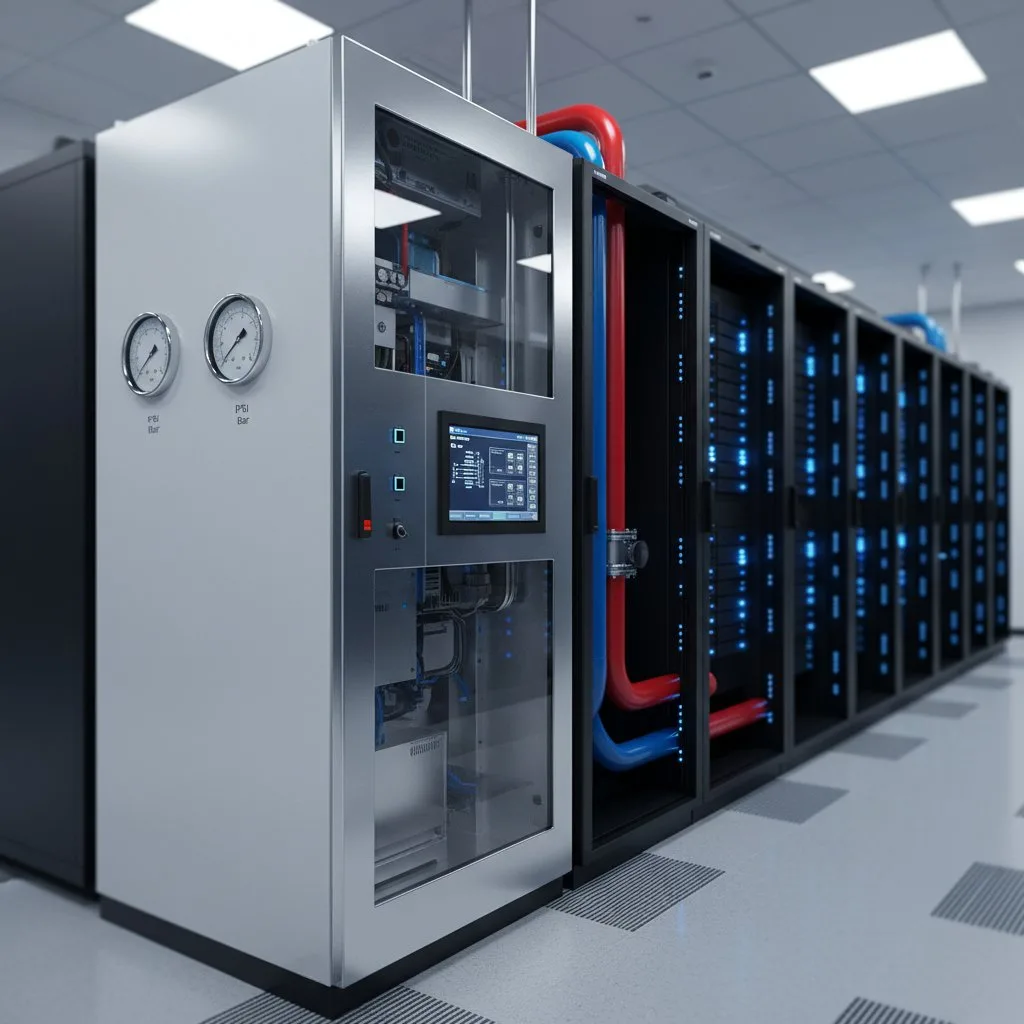
A Coolant Distribution Unit (CDU) is the heart of a liquid cooled rack. It separates the facility water from the clean loop that feeds your servers, and it controls the flow, pressure and temperature of that loop. If you are deploying AI or GPU racks above roughly 40kW, you will need one.
What a CDU actually does
A CDU sits between two water loops. The primary loop is facility water, coming from your chillers or building system. The secondary loop is a clean, controlled circuit that runs to the cold plates or manifolds inside the racks. The CDU transfers heat between the two through a heat exchanger while keeping them physically separate.
That separation is the entire point. Facility water is not clean enough or stable enough to push through the micro-channels of a cold plate sitting on a GPU. The CDU gives you a filtered, chemically correct, pressure regulated loop that server hardware can safely accept.
A CDU typically controls and monitors:
- Flow rate to the racks, usually in litres per minute
- Supply and return temperature of the secondary loop
- Loop pressure, and pressure differential across the racks
- Filtration and fluid quality
- Leak detection and alarms
- Redundant pumps, so a pump failure is not a rack failure
When do you need a CDU?
The trigger is rack density. Air cooling works well up to roughly 15 to 20kW per rack in a properly designed hall with containment. Between 20 and 40kW it becomes difficult, noisy and expensive. Above 40kW air is effectively finished, and modern GPU training racks run at 60kW to over 130kW.
So the short answer: if you are deploying dense GPU or HPC racks, or your rack design exceeds about 40kW, you are in CDU territory. If you are running ordinary enterprise workloads at 5 to 10kW per rack, you are not.
CDU types: in-rack and in-row
In-rack CDUs mount inside the cabinet itself, usually taking a few rack units. They suit single rack or small deployments and pilots, and typically handle tens of kW.
In-row (or floor mounted) CDUs are standalone units serving multiple racks, with capacities from hundreds of kW into the megawatt range. These are what you use for a real AI cluster.
There is also a split by loop type. A liquid-to-liquid CDU rejects heat into facility water and is the most common in datacenters. A liquid-to-air CDU rejects heat into the room and is used where no facility water exists, though it simply moves the problem into your air cooling.
How CDUs are sized
Sizing is driven by the heat you must remove and the temperatures you have to work with. Three numbers matter: the total IT load in kW, the supply water temperature available from the facility, and the allowable temperature rise across the loop.
As a rule of thumb, always size above your current load. Cooling capacity that is exactly equal to today’s IT load leaves you no headroom for the next node, a hot day, or a pump running degraded. Plan redundancy explicitly: an N+1 pump arrangement in the CDU means maintenance does not mean downtime.
Also remember that direct-to-chip cold plates typically capture 70 to 80 percent of the rack heat, not 100. The remaining heat still leaves the rack as air, and still needs air cooling. Designs that forget this end up with a hot room and a confused facilities team.
Installing and commissioning a CDU loop
Installation is a plumbing and controls job carried out inside a room full of very expensive electronics, which is why it is not a general mechanical contractor task. The sequence we use is:
- Assess the thermal load, the facility water available and the floor loading
- Design the loop: CDU placement, manifold and pipe routing, valve and disconnect strategy
- Install pipework, manifolds and the CDU, with isolation valves so racks can be serviced
- Pressure test and leak test the entire loop before any server is connected
- Fill with the correct fluid, bleed all air out of the system, and verify flow to every rack
- Commission under real load, verify temperatures and pressures, and hand over documentation
Air in the loop and wrong fluid chemistry are the two most common commissioning failures. Air causes hot spots and pump cavitation. The wrong fluid corrodes cold plates and voids hardware warranties.
Leaks: the question everyone asks
Liquid and servers sounds alarming, and it is the first objection every time. The engineering answer is that a properly installed loop uses dripless quick disconnects, is pressure tested before fluid meets hardware, runs leak detection at rack and CDU level, and is commissioned under load.
In practice, the risk of a well installed liquid loop is lower than the near certainty of thermal throttling if you try to air cool a 100kW rack. The failure mode that actually costs you money is the quiet one: accelerators that never deliver the performance you paid for.
Frequently asked questions
What does CDU stand for?
CDU stands for Coolant Distribution Unit. It is the unit that isolates and controls the liquid cooling loop feeding your racks, separating clean secondary coolant from facility water and regulating flow, pressure and temperature.
When do I need a CDU?
Once rack density passes roughly 40kW, air cooling is no longer practical and you need liquid cooling with a CDU. Typical triggers are GPU training racks, HPC clusters and any high density AI deployment.
What is the difference between in-rack and in-row CDUs?
In-rack CDUs mount inside a single cabinet and suit pilots or small deployments at tens of kW. In-row or floor mounted CDUs are standalone and serve many racks, scaling from hundreds of kW to megawatts.
How much heat does a CDU remove?
It depends on the unit, from tens of kW for in-rack models to well over a megawatt for large floor mounted CDUs. Note that direct-to-chip cold plates usually capture 70 to 80 percent of rack heat, so some air cooling is still required.
Can a CDU be retrofitted into an existing datacenter?
Often yes, provided there is facility water available and the floor can take the load. Where no chilled water exists, a liquid-to-air CDU or rear door heat exchanger may be the better route. A survey confirms which is realistic.
Do CDUs need maintenance?
Yes. Fluid quality checks, filter changes, pump servicing and leak detection testing should be scheduled. Coolant chemistry drifts over time and degraded fluid damages cold plates.
Read next: our datacenter cooling guide and server rack sizing guide. If you are planning a deployment, see CDU and liquid cooling installation or request a site survey.